The Discworld Wobbles
A mild rebuke of a Boomerlib fantasy world

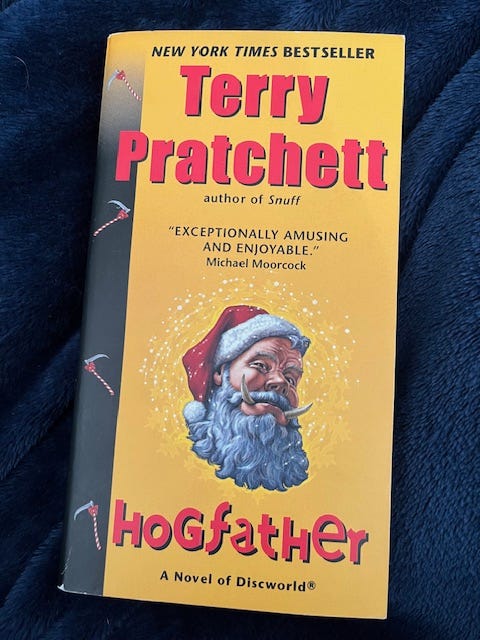
For the season I re-read Hogfather, Terry Pratchett’s take on the Santa Claus mythology set in Discworld. I loved it before but now, reading with a Right-shifted political soul it was...ok.
I haven’t read all the Discworld books, but I have read a good number of them. My science fiction/fantasy mass paperback book shelve is mostly Discworld right now, as I’ve rotated out older books I haven’t read (regretfully—the purge happened before the book censorship became public knowledge, and now some of those may never go in print again; I hope someone picked them up and is preserving them). I like the City Watch books the best due to the police procedural structure and Sam Vimes’ weary demeanor. The silliness of the wizards of Unseen University are a great lampooning of academia. Death (sorry: DEATH)* is the most fun character of them all, and lets Pratchett make many thoughtful musings on the meaning of life.
Hogfather was still a pleasant read. Pratchett’s writing elicits at least one smile or chuckle per page, rife with puns and word play (about the activities of a group of thieves and occasional murderers: “There was always something that needed transferring from A to B or, of course, to the bottom of the C”). The scene when the replacement Hogfather (no spoilers) does the mall Santa thing is fantastic, a great send up of consumerism and bratty children and bossy parents.
But I also found myself wincing at a few things, where in previous Discworld readings I did not.
Foremost is Pratchett’s idea that human (and dwarf and troll etc.) belief leads to the existence of the gods, not the other way around. This goes for spirits as well, so in Discworld Santa Clause/Hogfather exists because people believe he does. If the belief fades, then he/she/it fades as well. Pratchett expands this idea to its full extent in Small Gods, which coincidentally was the first Discworld book I read, at the recommendation of an atheist friend.
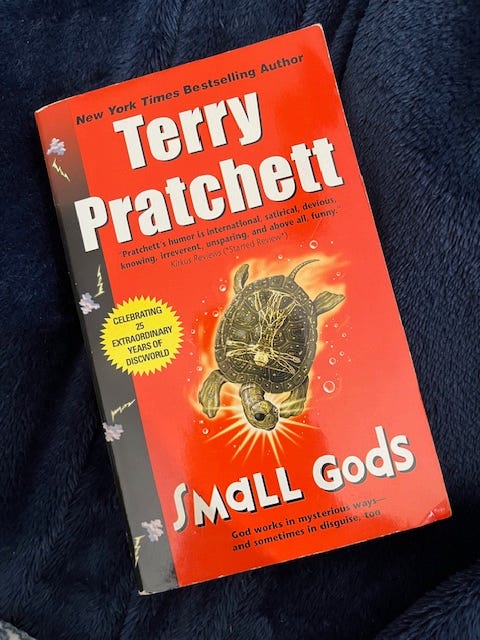
This is straight up post-modern “I’m spiritual not religious” nonsense, and the perfect summation of the idea that people can determine their reality by their belief. If I don’t believe there’s a God or gods, then I’m not subject to their rules. If I don’t believe, they just go away—as does all the moral requirements they put on human behavior. It’s the crystal-gazing, New Age solipsism acted out in a fantasy world where it can really come true.
In the real world, this self-definition of reality leads to all sorts of problems, which I’m not going go expound on again here. We know what they are. But over all, it leads to a disintegration of shared values that make a high-trust society difficult. Everyone gets their own special reality, right? And as a recent Christian convert, I can say it’s definitive that God exists if I like it or not. He’s certainly not asking me for permission to rule all of His creation.
Violence is always a problem in Discworld, but not for the reasons you may think. There’s an uncomfortable dichotomy between “good” and “bad” violence, based not only on “is this violence for the reason of protection of the innocent?” but also, “is this violence being performed by charming people?” Earlier, I quoted a line to demonstrate the cleverness of Pratchett’s writing, but it also demonstrates his Dickensian weakness for the extra-legal activities of those at the lower end of Discworld’s society. It’s cute when the poor do it.
Violence is also acceptable when the rich do it, if for the right reasons. Early in Hogfather the leader of the Assassin’s Guild is retained to remove the Hogfather from existence.
Lord Downey was an assassin. Or, rather, an Assassin. The capital letter was important. It separated those curs who went around murdering people for money from the gentlemen who wished to have removed, for a consideration, any inconvenient razor blades from the candyfloss of life.
The Assassins, being men of good breeding, are allowed to take life for their various reasons, much like how dueling was once a perfectly acceptable, even socially encouraged, manner of addressing issues between gentlemen. If the rich and powerful want to use violence against each other, what is the issue? It’s not being used against the poor after all. Never mind that the poor don’t get a say in their leadership anyway, regardless of who is assassinated or not. The deadly game among the elite is an acceptable and, in Discworld, a humorous way of weeding out those who are undeserving of power. Because, as per the moral structure of that universe, the right side conveniently wins. Always.
However there is one form of violence that is always unacceptable on Discworld and that is, of course, the violence of bigotry and racism. But don’t worry! The City Watch is on the job, keeping the Discworld safe for all species. In Thud!, a generations-long fight between the dwarfs and trolls (Pratchett’s main stand-in for racist conflicts) erupts on the streets of Ankh-Morpork, the greatest city on Discworld and the center of most of the stories in the series. In his investigations City Watch Chief Sam Vimes discovers a magic box that, acting as a tape recorder, reveals recordings of ancient dwarf and troll leaders saying that, actually, they made peace a long time ago and everyone really should get along. Meanwhile, back in Ankh-Morpork, young trolls and dwarfs are making their own peace by playing the board game Thud! in gaming cafes (no, really. That’s the plot). (And you too can buy Thud! The Board Game from Amazon or your local game shop. Arrange a game night with your local Muslim Brotherhood chapter to help promote interfaith dialogue).
But in the end, when all else fails and the peace cannot be kept between the various factions and species of Discworld, there is the final arbitrator (besides DEATH of course); the defacto dictator of the city of Ankh-Morpork, Lord Vetinari. Himself an Assassin, Vetinari in many Discworld books uses subterfuge, dishonesty and manipulation to achieve the “right” outcome for the plot, an outcome that always is fair, leads to justice, and punishes the wicked. He is the very model of the benevolent dictator.
Why would Pratchett, who otherwise demonstrates a great love of humanism and the potential of individuals to live a free life, put such a figure in power over his characters?
Vetinari exposes, unwittingly I assume on Pratchett’s part, the Boomerlib Leftist dark desire for authoritarianism. Yeah things would be awesome if everyone was cool and got along. But there are still some bad people out there and they stubbornly won’t be nice and actually they point out where our great ideas don’t seem to work so well and the people might start listening to them so it sure would be good if someone with power would just…make the bad people go away.
Those who are morally correct, or at least charming, in the Discworld universe are allowed to use all the violence they wish. But some violence is still bad, the violence begat by bigotry and racism. Naturally in Discworld the good always wins and everyone gets along more or less. The trolls don’t say “screw it, let’s genocide all the little dwarves, the bastards.” Or vice versa. The peace is conveniently kept, nicely or not.
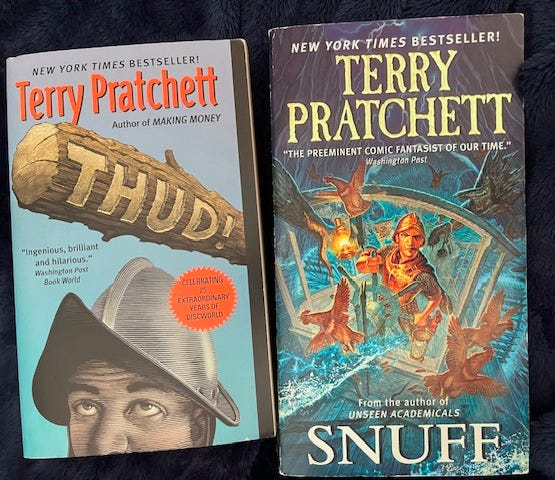
Towards the end of his life, especially in one of the the final Discworld books, ’Snuff, Pratchett seemed to be boiling over with frustration that the Boomerlib world of infinite empathy and acceptance wasn’t going to come into being. In this book (again, about racism) Vimes and his wife fight bigotry against goblins by hosting a music recital at the Ankh-Morpork Opera House for the city’s nobles and glitterati who, of course, are moved to open their hearts to the previously-despised goblins.
Look, I get it. Really. It would be nice if old hatreds could be solved with a harp recital or a board game but…
It’s all so naive.
The old bugbears of racism, sexism and class warfare are not going away. Even when the West fully acted out its liberal ideals, that didn’t mean that non-Western societies were impressed and wanted to emulate us; instead, it made us easy marks for those with a more tribal, illiberal worldview. Often, the neo-bigotry came from Leftists inside the house. Pratchett, who died in 2015, didn’t get to see the extreme bitterness generated by Leftist “Wokeness.” Would he have been able to write a “reverse-racism” Discworld book, addressing the degradation of men, Whites and heterosexuals in post-2015 Western culture? I doubt it. That reality is something the Boomerlibs still can’t see. The John Lennon song didn’t happen, and they don’t know why. They’re just angry.
Every once in a while I run across a mention of some once-famous but now forgotten author (“Charles Smoodley-Essex, bestselling author in Great Britain in 1889!”). Someone who was a big deal in their day but for various reasons no one alive today has heard of them or their books. Perhaps the writing style is too archaic, or the subject matter didn’t age well. For various reasons, their work, once lauded, did not stand the test of time. The world moved on while the author didn’t. Whatever they had to say in 1889, it wasn’t universal or timeless. I have a feeling this will be Discworld.
I don’t want to give the impression that I hate Discworld, or Pratchett. The books are still enjoyable, humorous, and good for taking a break from heavier reading. If you’re a D&D player whose games tend to devolve into entertaining silliness, you’ll be right at home. But I now get sad when I read these books.
Reading Discworld now is an exercise in nostalgia. It depicts the world the West was reaching for and failed to reach. Not because a universal idea of peace and good will is necessarily bad—it’s just impossible. Human nature is not the “be a heckin’ good person!” wishful thinking of the Reddit secular humanists. Our nature is dark and there are monsters. Wishful thinking, benevolent dictators, convenient plot twists and board games with your enemies will never change that.
I’m not saying don’t read Pratchett. The Discworld books are still a lot of fun, the writing is clever and funny, the characters delightful, and the world warm and cozy. But realize they are relics of a fading ideology. It’s a Boomerlib fantasy.
* I tried to get the small cap for Death’s name but Substack’s writing tools didn’t have a way of doing it. Grrrr.
You're right, Pratchett is becoming increasingly ideologically dated, but most of the humor still stands up, at least for the first 17 or so (of ~34 IIRC) Discworld books. After that, I think a combination of aging (including incipient Alzheimers) and increasingly doctrinaire conventional woke attitudes in the world after the turn of the millennium combined to make the books more and more stale.
Pratchett subverts many woke dogmas and shibboleths, too, though. Reg is a literal zombie leftist. The Hogfather bringing everyone sausages is a jab at vegetarians. I don't think the imps painting fast in the cameras ever get freed. Veternari has a scorpion pit and torturers, I believe. He also keeps the da Vinci-like character who keeps innocently inventing superweapons incommunicado for everyone's safety. Trolls really are almost always stupid, and their class is immutable depending on what stone they're made of. Cheery Littlebottom of the Watch rebels agaist dwarf unisex norms to dress as her biological sex. There's at least one problematic Earth stereotype in nearly all the books that is more played up than subverted, e.g. Jewish Hollywood executives in *Moving Pictures*, or all the other nations on Discworld that have obvious Earth-equivalents. Most of all, Ankh Morpork is an eternal cesspool filled with criminals and entertainingly awful people who are in no way role models until after the series jumps the shark. (Vimes being an exception, but he starts off flawed, too. Carrot is more complicated, though wholly good and heroic, he's not a fool, and as rightful king he has to keep his head down to keep it on his neck. He's a foil for contrast, but Pratchett doesn't do anything too bad to him, the way a real evil leftist author would have.)
Besides the characters being entertainingly awful, not role models, another point is that there's no way to make unflawed, intelligent, all-good protagonists who are on the side of right and do no wrong and are funny. At least I can't think of anyone who's pulled it off. Douglas Adams' Krikkiters, maybe, but they did try to kill off the rest of the universe. Which is the thing the right hasn't yet fully come to terms with: when you really are the best, and everybody else is trying to erase your people, you have to let go of the schoolmarmish / churchian false morality and actually mass-genocide your enemies without any hand-wringing. Impotent spite isn't going to cut it (or them), nor can we empathize or treat them as "us", like the men of Krikkit going outside their home nebula and seeing the galaxy for the first time, and calmly saying: "it'll have to go", then proceeding without any angst, that's the sort of attitude needed. If we can laugh after doing it, so much the better, maybe. But I think we have to get serious first before we can find total war humorous.
Much as I disagreed with the premise of small gods, it's still a great book about the space that often grows between a religion and its institutions.